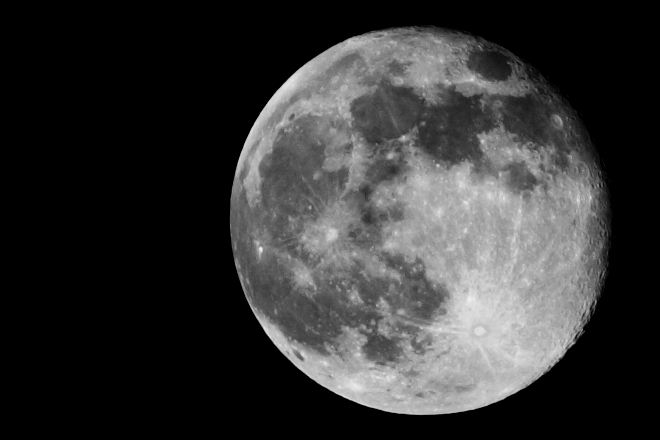
If you have access to a normal compact digicam and a pair of binoculars, and are prepared for Some Faff, you can probably achieve results of that order ... you need to hold the binocs to the camera lens, focus the camera at infinity, focus the binocs until focussed, take photo. HOLD EVERYTHING STILL.
10x binoculars on a 100-mm-equivalent lens (the far end of the optical zoom on most compact digicams) give you the equivalent of a lens twice as long as rjk used for that shot.
I've managed this on terrestrial targets, I've got some quite nice video from the Fairford air show; I tried with my telescope on the Moon and got nothing, but my telescope is hopelessly wobbly.
It's apparently just passed its highest point in the sky for eighteen years and is also (possibly connectedly; my planetary physics is not what it should be) quite close to the earth at the moment.
![[personal profile]](https://www.dreamwidth.org/img/silk/identity/user.png)
(no subject)
Date: 2005-12-17 12:09 am (UTC)I want a camera that can do that.
(no subject)
Date: 2005-12-17 01:28 am (UTC)(no subject)
Date: 2005-12-17 05:50 pm (UTC)(no subject)
Date: 2005-12-18 01:36 pm (UTC)If you're looking for practical difficulties, "illuminating the whole moon" is probably worse.
A patent fivemack recipe
Date: 2005-12-17 10:01 am (UTC)10x binoculars on a 100-mm-equivalent lens (the far end of the optical zoom on most compact digicams) give you the equivalent of a lens twice as long as rjk used for that shot.
I've managed this on terrestrial targets, I've got some quite nice video from the Fairford air show; I tried with my telescope on the Moon and got nothing, but my telescope is hopelessly wobbly.
(no subject)
Date: 2005-12-17 02:08 pm (UTC)(no subject)
Date: 2005-12-17 11:28 am (UTC)(S)