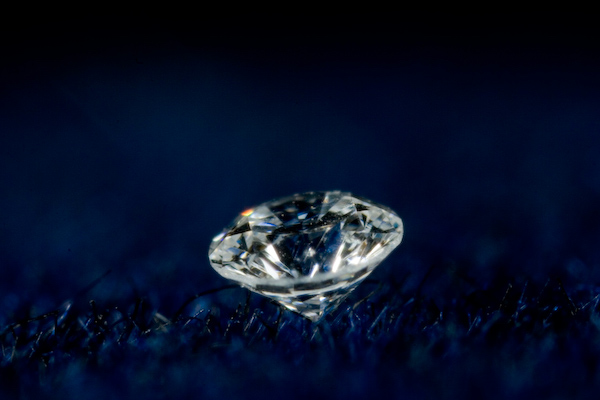
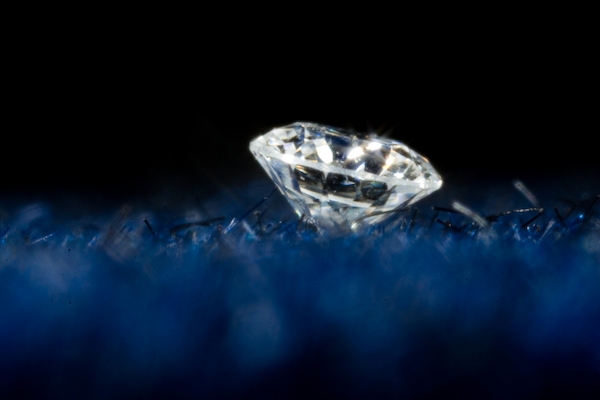
Large (which I think in this context means one-carat, which is 200mg, about 6mm in diameter so overfilling rjk's lens-and-sensor combination by a factor two, and costing something between three and twenty thousand pounds cut) diamonds are cut by hand, generally in Antwerp, with substantial computer assistance; small ones must be CNC'd, since that diamond cost me ten Euros and the sheer fiddliness of the setup for that many facets would take more than ten Euros worth of even Chinese labour costs. I didn't ask whether it was a mined or a vapour-deposited diamond; I'd guess mined, given how sniffy the diamond industry in Antwerp seems to be about synthesis.
The automation for diamond-cutting is wonderful; I don't know if it's extremely accurate servos or some kind of interferometry, but they manage to capture the shape of the rough diamond as a point-cloud at about 10um precision, capture the position of the flaws with comparable accuracy, and then do the nasty optimisation problem of 'how large a copy of this weird polyhedron, arbitrarily rotated, translated and uniformly scaled, fits precisely inside this point-cloud avoiding the following list of flawed volumes'. There are only a few 'valid' cuts (since a lot of angles have to be exactly 24.4 or 66.6 degrees to get the total internal reflection effects that make diamonds so shiny); I think optimising the shininess of a polyhedron fitting inside a rough diamond of a given shape is possible, but would be both computationally painful and produce something that traditional jewellers (and jewellers are traditionally very traditional) would be unhappy selling.
![[personal profile]](https://www.dreamwidth.org/img/silk/identity/user.png)
(no subject)
Date: 2006-08-22 08:04 pm (UTC)(no subject)
Date: 2006-08-22 08:37 pm (UTC)(no subject)
Date: 2006-08-23 07:55 am (UTC)(no subject)
Date: 2006-08-22 09:13 pm (UTC)(no subject)
Date: 2006-08-23 07:56 am (UTC)(no subject)
Date: 2006-08-22 11:13 pm (UTC)(no subject)
Date: 2006-08-23 10:10 am (UTC)The automation for diamond-cutting is wonderful; I don't know if it's extremely accurate servos or some kind of interferometry, but they manage to capture the shape of the rough diamond as a point-cloud at about 10um precision, capture the position of the flaws with comparable accuracy, and then do the nasty optimisation problem of 'how large a copy of this weird polyhedron, arbitrarily rotated, translated and uniformly scaled, fits precisely inside this point-cloud avoiding the following list of flawed volumes'. There are only a few 'valid' cuts (since a lot of angles have to be exactly 24.4 or 66.6 degrees to get the total internal reflection effects that make diamonds so shiny); I think optimising the shininess of a polyhedron fitting inside a rough diamond of a given shape is possible, but would be both computationally painful and produce something that traditional jewellers (and jewellers are traditionally very traditional) would be unhappy selling.
(no subject)
Date: 2006-08-23 10:15 am (UTC)(no subject)
Date: 2006-08-23 12:13 am (UTC)Shinycoruscatey!