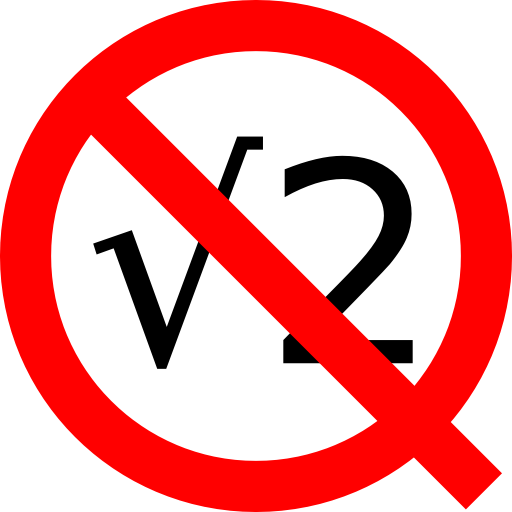
A stylized Q is used to denote rational numbers (http://mathworld.wolfram.com/RationalNumber.html). The square root of 2 is a well-known example of an irrational number.
I could only read it as "No Irrationality" or similar before reading the comments - the Q doesn't count unless it's blackboard bold IMHO! Pretty though.
Blackboard-bold is common but by no means universal - plain old bold turns up in some works. Whatever the stylization the point is Q-for-quotient, not the font.
I've been inclined to think of it as a symbol based on a "Q" myself, though I admit the distinction is fuzzy, certainly it's still often written as a "Q" and pronounced as a "Q".
I know I know, I'm just making excuses for not having seen it. (There's one in the title of my PhD thesis, as it happens, and I remember being mildly unhappy that the bookbinder couldn't do blackboard bold on the spine!)
I assume the blackboard bold was exactly that. An attempt to reproduce the printer's bold on a blackboard. The printer was emulating the pen; I bet if you use a quill or other broad-nibbed pen you can do normal weight and bold quite easily.
At some point the printers started emulating the blackboard, and TeX set everything in stone.
It's realted to the convention of putting a wiggly underline on your named vectors. That's an editor's instruction to the typesetter to use bold weight characters. That convention hasn't been very widely emulated in print yet (thank goodness).
√2 or "square root of 2" means "the number that when multiplied by itself gives 2". It's the length of the diagonal of a square where the sides are 1 unit long. It's about 1.414, but not exactly: in particular, you cannot write this number as a fraction.
The set of all the numbers that you can write as fractions is called Q (for "quotient"). The pun is that the sign both looks like a Q and also declares that √2, which is not a member of Q (because you can't write it as a fraction), is prohibited.
![[personal profile]](https://www.dreamwidth.org/img/silk/identity/user.png)
(no subject)
Date: 2007-05-31 08:55 pm (UTC)(no subject)
Date: 2007-05-31 09:09 pm (UTC)(no subject)
Date: 2007-05-31 10:17 pm (UTC)(no subject)
Date: 2007-06-01 12:03 am (UTC)Nicely done though *grin*
(no subject)
Date: 2007-06-01 07:55 am (UTC)(no subject)
Date: 2007-06-01 08:05 am (UTC)(no subject)
Date: 2007-06-01 08:15 am (UTC)(no subject)
Date: 2007-06-01 10:25 am (UTC)(no subject)
Date: 2007-06-01 10:40 am (UTC)(no subject)
Date: 2007-06-01 10:50 am (UTC)(no subject)
Date: 2007-06-01 10:53 am (UTC)(no subject)
Date: 2007-06-01 11:24 am (UTC)(no subject)
Date: 2007-06-01 05:36 pm (UTC)(no subject)
Date: 2007-06-01 05:55 pm (UTC)At some point the printers started emulating the blackboard, and TeX set everything in stone.
It's realted to the convention of putting a wiggly underline on your named vectors. That's an editor's instruction to the typesetter to use bold weight characters. That convention hasn't been very widely emulated in print yet (thank goodness).
(no subject)
Date: 2007-06-01 10:17 pm (UTC)√2 or "square root of 2" means "the number that when multiplied by itself gives 2". It's the length of the diagonal of a square where the sides are 1 unit long. It's about 1.414, but not exactly: in particular, you cannot write this number as a fraction.
The set of all the numbers that you can write as fractions is called Q (for "quotient"). The pun is that the sign both looks like a Q and also declares that √2, which is not a member of Q (because you can't write it as a fraction), is prohibited.
The √ sign is sometimes called a "radical sign".
(no subject)
Date: 2007-06-01 10:20 pm (UTC)means "the number that when multiplied by itself gives 2"
Possibly I should mention that there are two such numbers, though perhaps this is not immediately helpful in context...