![[personal profile]](https://www.dreamwidth.org/img/silk/identity/user.png) ewx
ewxI’ve been reading Old English and Its Closest Relatives by Orrin Robinson. This is a survey of a variety of Germanic languages from the past couple of millennia, starting with a general overview and then proceeding to chapters on individual languages, starting with Gothic. The reader is soon invited to attempt translation of some sample texts, with the assistance of a glossary and some grammatical notes.
Gothic is the oldest of the languages discussed, giving it the greatest time distance from the modern English that I’m familiar with. However, it is also closest to the assumed common ancestor of all Germanic languages, giving it less time to accumulate unique features. It’s also the most geographically distant, having been spoken as far east as modern Ukraine, though its ultimate origins may lie in ancient Scandinavia.
There are plenty of cognates to be spotted, both with English and more distant languages. A good example would be 𐌷𐌰𐌱𐌰𐌽 haban “to have”, which is related to modern German haben (see comments for discussion re Latin habeo). Another good example is 𐌷𐌰𐌿𐍃𐌾𐌰𐌽 hausjan “to hear”; this is related not only to “hear” (there’s a /z/ > /r/ sound shift in west Germanic languages) but also to “acoustic” (Greek not having the /k/ > /x/ sound shift of Grimm’s Law). There are plenty of other examples, and they did help somewhat with the translation.
Indicating verb tense by a vowel change is common in Gothic. For example, 𐌵𐌹𐌸𐌰𐌽 qiþan “to say”, becomes 𐌵𐌰𐌸 qaþ in the past tense - “(he) said” (or “quoth”; 𐌵 is pronounced /kʷ/.) One class of verbs, though, gets its past tense by a process called reduplication. For instance, 𐍃𐌰𐌹𐌰𐌽 saian “to sow” becomes 𐍃𐌰𐌹𐍃𐍉 saiso “(he) sowed”.
The language is heavily inflected (at least compared to what I’m used to). Nouns and adjectives inflect for number and case; moreover adjectives have two parallel systems, the weak and strong declensions, with the choice depending on the presence or absence of a definite article. Verbs are worse still: not only do they inflect for mood, person and number but the present and preterite participles (analogous to English “driving” and “driven” respectively) are adjectives, thereby dragging all of the complexity of that class into the verbal system. And yet despite all this, there is no future tense, meaning that the present has to do double-duty.
More charmingly, at least from the perspective of my particular obsessions, it has a dual: 𐌽𐌹𐌼𐌰 nima “I take”, 𐌽𐌹𐌼𐍉𐍃 nimos “we two take”, 𐌽𐌹𐌼𐌰𐌼 nimam “we take”.
Putting all of the above together meant that the translations felt a bit more like actual translation and less like looking up words in a glossary and rearranging until they made sense in English. I’ve since moved onto the chapter on Old Norse, and while it does have some grammatical information it is somewhat less detailed, making the translation effort somewhat less rewarding. Still, I’m less than half way through it.
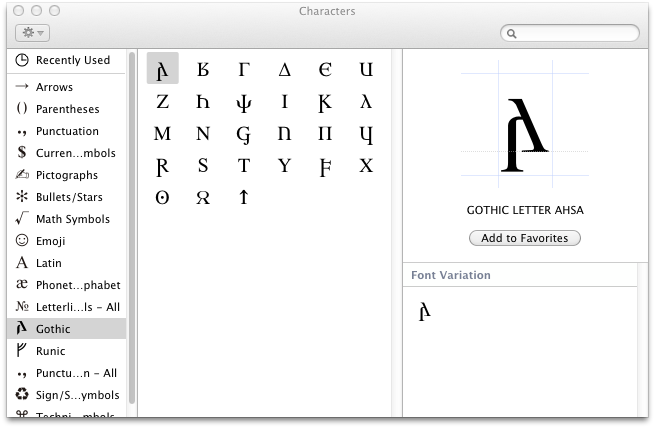
(If your browser doesn’t display the Gothic characters used in this article, they look like this.)
(no subject)
Date: 2012-04-04 07:27 pm (UTC)(no subject)
Date: 2012-04-04 07:34 pm (UTC)(no subject)
Date: 2012-04-04 09:00 pm (UTC)