Morning medical annoyance
Mar. 23rd, 2026 09:00 am![[personal profile]](https://www.dreamwidth.org/img/silk/identity/user.png) andrewducker
andrewduckerIt always surprises me that Boots isn't open until 9am. You would have thought that there'd be enough people wanting to pick up painkillers or similar on the way in to work.
andrewduckerIt always surprises me that Boots isn't open until 9am. You would have thought that there'd be enough people wanting to pick up painkillers or similar on the way in to work.
![[syndicated profile]](https://www.dreamwidth.org/img/silk/identity/feed.png) eaglespath_feed
eaglespath_feedReview: Dark Class, by Michelle Diener
| Series: | Class 5 #5 |
| Publisher: | Eclipse |
| Copyright: | 2022 |
| ISBN: | 0-6454658-2-8 |
| Format: | Kindle |
| Pages: | 349 |
Dark Class is the fifth novel (not counting the skippable novella) in Michelle Diener's Class 5 romantic science fiction series. As with the previous novels, this follows romance series conventions: There are new protagonists, but characters from the previous books make an appearance. It's helpful but not that necessary to remember the details of the previous books; the necessary background is explained enough to follow the story.
By now, series readers know the formula. Yet another Earth woman was secretly abducted by the Tecran, encounters a Class 5 ship, and finds a way to be surprisingly dangerous and politically destabilizing. This time, Ellie has been mostly unconscious since her abduction and awakes in a secret Tecran base after the Tecran have all been murdered. There is a Class 5 AI involved, but not a full ship; instead, Dark Class picks up (or, arguably, manufactures) a loose end from Dark Minds. Other than that break from the formula, you know what to expected by now: a hunky Grih, a tricky political standoff, a protective Class 5, a slow-burn romance, and a surprisingly capable protagonist who upends politics through plucky grit and refusal to tolerate poor treatment. Oh, and a new selection of salvaged clothing and weapons to make Ellie beautiful and surprisingly dangerous.
If you are this far into the series, you probably like the formula. That's my position. I don't care about the romance, but something about the prisoner to threat evolution of the kidnapped protagonists and the growing friendship with an AI makes me happy. This is not great literature, but it is reliably entertaining with a guaranteed victorious protagonist and happy ending, making it a comfortable break from more difficult books with emotionally wrenching scenes.
Dark Class is one of the better executions of the formula because it has long stretches of my favorite parts of these books: exploration of mostly-abandoned surroundings for neat gadgets while the AI and the protagonist slowly build a relationship of mutual respect. This book has bonus drones with minds of their own and an enigmatic alien spaceship that provides a fun mid-novel twist. The Tecran and the Grih repeatedly underestimate Ellie and are caught by surprise at dramatically satisfying moments. It's just fun to read, and I save this series for when I need that type of book.
As with the other books of the series, Diener's writing is serviceable but not great. She repeats herself, uses way too many paragraph breaks for emphasis, and is not going to win any literary awards for prose quality. The series is in the upper half of self-published works, and I've certainly read worse, but either the formula will click with you or it won't. If it doesn't, the prose is not going to salvage the book.
There is some development of the series plot, but it's mostly predictable fallout from Dark Matters. This book is mostly tactical and smaller in scale. I am a little curious where Diener is going with political developments, since the accumulated Earth women and Class 5 ships are in some danger of becoming a sort of shadow government through sheer military power, but I'm dubious this series will have enough political sophistication to dig into the implications. It's best enjoyed as small-scale episodic wish fulfillment for female protagonists, and that's good enough for me.
If you've read this far in the series, recommended; this is one of the stronger entries.
Followed by Collision Course, which breaks the title convention for the series.
Rating: 7 out of 10
tacit_feedA couple of days ago, I saw a question on Quora asking why Christian movies always suck. Thing is, Christian movies don’t (necessarily) suck. American Evangelical propaganda movies tend to suck, but there are some extraordinary Christian movies out there, and I say this as an atheist.
I refer, of course, to Knives Out 3: Wake Up Dead Man, which is a brilliant, entertaining, and very Christian movie—probably the best Christian movie of the last two decades.

“But Franklin!” I hear you say. “Wake Up Dead Man has an atheist protagonist! The antagonist is a corrupt religious preacher who builds a dysfunctional cult of personality around himself! This is in no way a Christian movie!”
Ah, but watch this scene, where our atheist protagonist, Benoit Blank, first meets another major character, Father Jud Duplenticy, who is sent out to the corrupt priest’s parrish:
The entire movie has some absolutely marvelous dialogue, but this scene in particular stands out. When Blank enters, and Father Jud asks him what he thinks of the church, he has something pretty scathing to say:
Well, the architecture, that interests me. I feel the grandeur, the mystery, the intended emotional effect. And it’s like someone has shown a story to me that I do not believe. That is built upon the empty promise of a child's fairy tale, filled with malevolence and misogyny and homophobia. And it’s justified untold acts of violence and cruelty while all the while, and still, hiding its own shameful acts. So like an ornery mule kicking back, I want to pick it apart and pop its perfidious bubble of belief and get to a truth I can swallow without choking. Telling the truth can be a bitter herb. I suspect you can't always be honest with your parishioners.
Not a very Christian bit of dialogue, right?
Ah, but wait. Here's Father Jud’s reply:
You can always be honest by not telling the unhonest thing. You're right, it's storytelling. This church isn't medieval. We're in the middle of New York. It has more in common with Disneyland than Notre Dame. And the rites, the rituals, the costumes, all of it, you're right, it's storytelling. I guess the question is, do these stories convince us of a lie, or do they resonate with something deep inside us that is profoundly true, that we can't express any other way except storytelling?
I, as an atheist, found Father Jud’s answer quite moving.
But it goes so much further than that. This scene is a masterclass of cinematic storytelling, of show rather than tell. You could teach an entire course in composition and visual design just from this one scene. Let’s go through it, shall we?
At the start of the scene, Benoit Blanc, our atheist, walks into the church. The door is behind him; the aisle down through the center of the church is shrouded in darkness. He, as he says at the scene’s start, “worships at the altar of the rational.”

He’s confident, self-assured, secure in his position.
Father Jud stands facing him, literally rather than figuratively standing in the light.

Father Jud approaches Benoit, asking him questions about himself, listening to his reply, meeting Benoit where he is.

Benoit walks past him. At this point, the two of them, atheist and reverent priest, have traded places.

“How does all this make you feel?” Jud says. At this point, Jud and Benoit have traded places, and you’ll see some astonishingly good face acting on Daniel Craig’s part.

Craig (Benoit Blank) asks him, “truthfully?” “Sure,” Jud replies, giving him permission to be frank. Benoit launches into his tirade: “I feel the grandeur, the mystery, the intended emotional effect. And it’s like someone has shown a story to me that I do not believe. That is built upon the empty promise of a child's fairy tale, filled with malevolence and misogyny and homophobia.”

While he speaks, pay attention to what happens around him. The formerly bright part of the church grows dark. The saturation is reduced, leaching the color from the scene. His words spin a veil of darkness that fills the space around him.

More incredible face acting from Craig as his words become more biting, more angry: “And it’s justified untold acts of violence and cruelty while all the while, and still, hiding its own shameful acts,” every word delivered like a bullet from a gun.
As he speaks, there’s some amazingly clever camera work. Benoit in the foreground, Father Jud in the background, the camera moves around so that Benoit, again literally and not figuratively, eclipses the pious priest, completely removing him from view. Benoit is not talking to Father Jud. He’s not even facing Father Jud. He’s talking to us.
It’s subtle but oh so well done, and it is absolutely intentional.


At the end, Benoit, realizing he’s said probably more than he intended to, and with more venom, offers to leave. Father Jud tells him, no, stay, I told you to be honest.

At this point, the entire church is shrouded in darkness. Father Jud isn’s standing in the light anymore. He and Blanc are cloaked in shadow, the darkness of Benoit’s words given physical form.

What is happening here? Father Jud has literally, not figuratively but literally, joined Benoit Blank in the darkness. He’s met Benoit where he is. He hasn’t stood above him, talking down to him. He is there, on the same footing, in the same place as Blanc. He pauses for a moment, and then he begins to speak.
What is the first thing he says? “You’re right.” He reiterates Benoit’s opening thesis: It is storytelling. The church itself, its physical form, is a story, and a false one, an illusion of a Medieval church built in modern times, as much an ancient cathedral as Cindarella’s castle is a real fortification.
Watch what happens as he speaks:

The light returns, shining from above him, almost passing through him. And when he’s finished...

...the atheist stands illuminated, bathed in the light of his words.
Father Jud doesn’t preach at the atheist detective from some higher plane. He meets Blanc where he is, he stands with him, he acknowledges the parts of Blanc’s argument that he believes are true, and then he offers a new way to interpret Blanc’s central thesis—all without condescention, judgment, or self-righteousness.
I am not a believer, but this scene still gave me chills. It’s immensely powerful. It resonates. It vibrates. This is masterful visual storytelling.
The reason people don’t recognize Wake Up Dead Man as a Christian movie is that too many of us have been conditioned by Christian™ movies, movies made by and for low-information, insecure American Protestant Evangelicals.
These movies are like the Chick tracts I used to collect back when I collected religious propaganda. They’re cartoons for the uneducated, caricatures in which every atheist is a slavering buffoon, every religious person clever and righteous, told to an audience so insecure in its faith that no atheist can ever be allowed to make any point and no religious character can ever be permitted the slightest doubt or fault.
American Evangelicals are a weird breed, convincing themselves they’re the persecuted ones at the same time they deliver a venomous mix of hatred and bile to all those who are not like themselves. They believe, they actually believe, that university professors demand their students sign statements renouncing Christianity in order to get a passing grade, then go home and drool over all the people they’ve deconverted that day.
By their standards, Wake Up Dead Man is not A Christian movie, because Christian movies have to look a certain way, a way that seems written by a drooling eight-year-old who’s never read more than three Bible verses for a Sunday School class.
There’s another scene that drives this point home even more. Benoit Blanc and Father Jud are hot on the heels of the murderer, a murderer they believe they will be able to identify if they can get one key piece of information from the church secretary, Louise. They’re this close to finding the killer. And, well...
...Louise reveals that her mother is in hospice, dying of brain cancer, and she fought with her mother, and her mother refuses to speak to her.
This scene broke me.
Father Jud is working with Detective Blanc to uncover a murderer, a high-stakes mission, but when faced with someone suffering right now, someone he has the power to help right now, he stops what he’s doing to care for her.
This is the absolute best of Christianity, the thing Christianity promises but all too often fails to deliver. It’s not highlighted, it’s not the centerpiece of the movie, it’s not delivered in a “look how good we Christians are, let’s rub it in the face of the callous evil atheists,” it’s just a thing that happens, because of Father Jud is who he is: a flawed but sincere exemplar of loving kindness, not a Christian™ (or an atheist) caricature of Christianity.
A Christian™ movie will never, can never deliver a scene like this.
Benoit Blanc ends the movie as he started, an atheist. There’s no scene in this movie like there is in every Christian™ movie where the atheist character falls to his knees and accepts Jesus Christ™ as his Lord and Savior™. That’s not the point.
The religious figures in the movie are not perfect. One of them is the film’s primary antagonist. That’s also not the point.
The point is, this movie delivers a blueprint, a template of the best that Christianity has to offer: kindness, humility, calm and patient virtue. It is without question a Christian movie, deliberately so, a Christian movie built and delivered with warmth and compassion. A Christian movie even atheists can enjoy.
That makes it far more effective than any Christian™ movie can ever be.
corrvinecosophia It's getting on for midnight and so it's time to launch a new Magic Monday. Ask me anything about occultism, and with certain exceptions noted below, any question received by midnight Monday Eastern time will get an answer. Please note: Any question or comment received after that point will not get an answer, and in fact will not be put through. If you're in a hurry, or suspect you may be the 341,928th person to ask a question, please check out the very rough version 1.3 of The Magic Monday FAQ here.
  I've also had quite a few people over the years ask me where they should buy my books, and here's the answer. Bookshop.org is an alternative online bookstore that supports local bookstores and authors, which a certain gargantuan corporation doesn't, and I have a shop there, which you can check out here. Please consider patronizing it if you'd like to purchase any of my books online.
 questionable_content_feed
Emily is my wife's favourite character so this story is basically a little present for her (and possibly...for you???)
hacker_news_daily_feedThe 10 highest-rated articles on Hacker News on March 22, 2026 which have not appeared on any previous Hacker News Daily are:
elfofearthandstarsToday has been much more lackluster. Budget sheet, meal planning, and grocery shopping is out of the way for the week, and I have just wrapped up our 2025 taxes. Federal are filed and in queue, the state will have to be mailed physically since we don't qualify for any of the free e-file options. I do need to work on my next 3-month goals and updating my planner, which I'll do shortly once I finally put the laptop away for the day.
It has been a beautiful weekend out, but The Pollening has seriously started in. I used to berate myself for not doing more gardening and outdoor spring planting, but the current state of being unable to touch nearly anything that has gone outside and being unable to get in and out of cars or go for walks without a physical reaction reminds me why that is.
I recently tried downloading Hoopla to see if it offered more options than Libby, but for my local library, the answer is no. I thought there was a secret trick somewhere to getting access to more library offerings for free, but at this time the most I can find is links to getting a non-resident card for an annual fee. (I mostly use my local county library for e-book offerings, but their selection is limited in a lot of ways.) I am hoping to read along with a work-based book club that has kicked off, but also do not want to necessarily need to purchase everything they cover. I do have some Bookshop.org gift money available, but I have reserved that for fun/want to reads of my own choosing.
The week ahead looks fairly quiet, except I have a therapy appointment that I am looking forward to/very much need.
May you be safe, may you be healthy and well, may you be content, and may you find beauty and joy in your present moment. ♥
 sovayselkie was safely collected from the Penn Station-alike that South Station has done its best to inhume itself into since her last visit, provided with an appropriate quantity of local barbecue for an obligate carnivore, and even successfully checked in to her hotel despite the mishegos attending every stage of her conference even before it started. At no point in this process did we apparently remember to take any pictures of ourselves.lovingbothoursin
This week's bread: Elizabeth's David's Light Rye Loaf, which turned out nicely even though I discovered that the fresh yeast had finally given up and I had to fall back on Allinson's Easy Bake Yeast (which is not, horrors, the same as their former Active Dry Yeast).
Friday night supper: grocery order came early enough that I was able to put in hand the makings of a sardegnera with pepperoni.
Saturday breakfast rolls: brown toasted pinenut, with Marriage's Golden Wholegrain Bread Flour, turned out quite well.
Today's lunch: game casserole - mixture of pheasant, venison, duck and partridge with onion, garlic, bay leaf, juniper berries, coriander seeds and red wine; served with kasha, warm green bean and fennel salad, and baby pak choi stirfried with star anise
smbc_comics_feed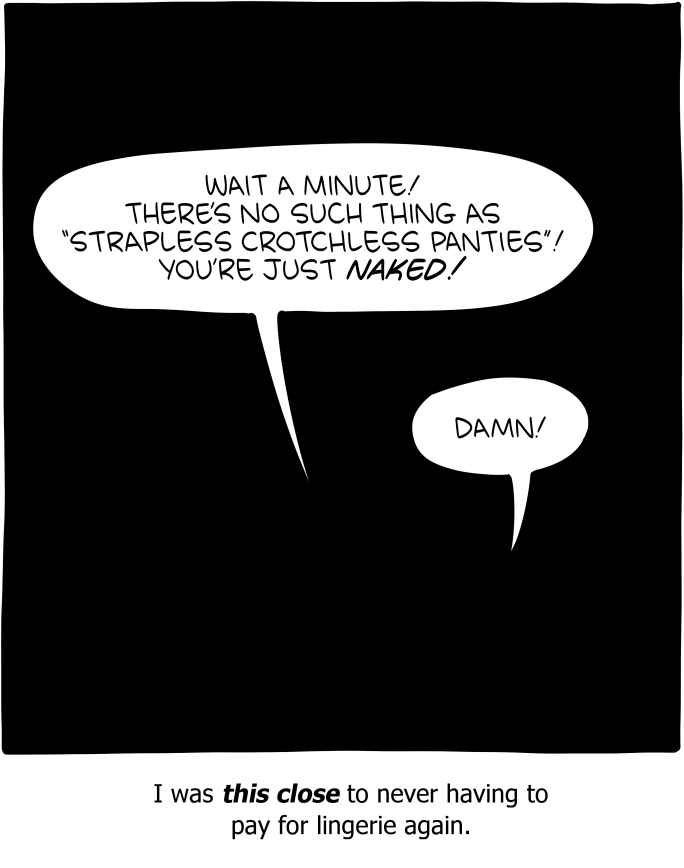
Hovertext:
Guess he's not buying the see-thru feel-thru corset either.
conulymdlbearNot a bad week. Home from the US Sunday noonish (was not keeping careful track, because at that point I'd been more than 24 hours without sleep). Predictably, sleeping better (or at least longer) than usual all week. Walks 6 days out of 7, plus bonus st/roll with N and (new scooter)Gizmo on Wednesday.
Gizmo is heavier than Lizzy, and doesn't fold as well, but he's more than twice as fast. N went and bought a helmet -- purple with flowers. Her name is Kore, which is "Colleen" translated from Irish to Greek. Lizzy is still in the shop - no telling when she'll be back. Yes, we name a lot of our stuff.
N and I have been checking out book marketers. A bit expensive, but we want to do a good launch for her next one, and need someone who knows what they're doing.
Linkies: 41-Year-Old Woman Celebrates One Year With Her AI Octopus Boyfriend and Says She’s “Fully Satisfied”
markov_stoats_feed james_davis_nicoll