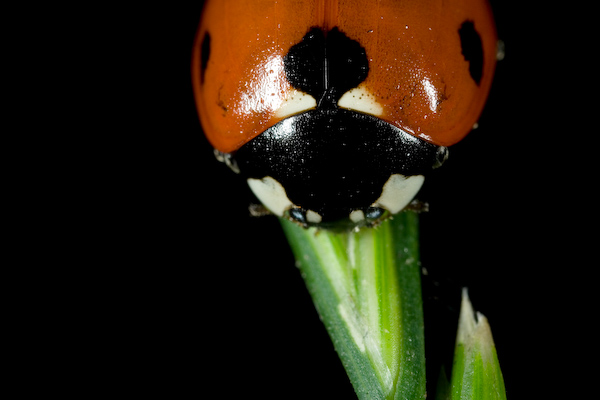
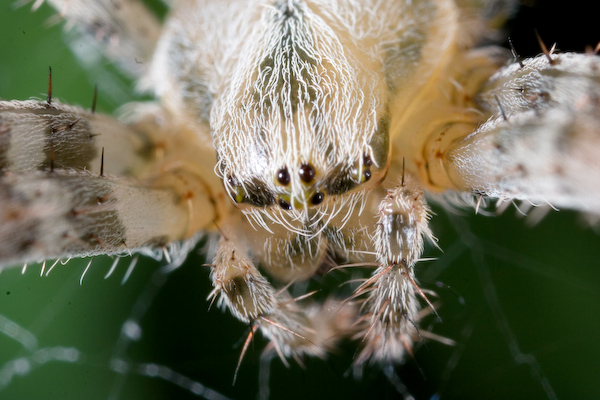
I would imagine that the spider's all hairy so that he can pick up on little vibrations like flies wandering along and whatnot. But I'm not a biologist, so that could be entirely wrong. :)
A lot of insects and spiders have hairs. I can remember doing breeding experiments with fruit flies at Uni to increase or reduce the numbers of hairs on particular areas of the flies' surfaces which could be done in a very few generations but I doubt if anyone bothered to ask the question as to what those hairs were doing there in the first place.
I expect hairs on different creatures are called in to serve different purposes of insulation, sensation, making the creature less palatable, reducing friction, increasing friction, making their shape less obvious to predators and repelling water according to lifestyle.
There's a patch in one of my flowerbeds which is clearly a nursery of smaller grey spiders; are the ones of which your garden's full the ones with nearly bumble-bee-sized abdomens which live free-floating in really substantial webs anchored to vegetation? Looks like it from the shot; haven't uploaded my Spiders Of The Day yet.
Yes, I think they are all orb weavers, grown large over the summer, and constructing impressive webs to catch the evening's crop of really stupid leggy flying things.
The big spiders are garden orb-weavers, Araneus diadematus. My garden and all my neighbours' gardens are full of them, and thank goodness, because otherwise we'd be even more inundated with common crane flies, Tipula oleracea. (Adult crane flies, known as "daddy longlegs", are harmless long-legged blundering things, but their larvae, known as "leatherjackets", are voracious garden and agricultural pests.)
Four garden orb-weavers have been building their webs outside my front window each morning for the last couple of weeks, in the same places each day, and I watch them eat their breakfast as I eat mine. They carefully wrap the prey up until it's completely cocooned and then they suck it dry. When they are done they snip the thread holding up the husk and it falls into the vegetation below.
The big orb-weavers are females that are in their second year. Soon they will lay their eggs and then they will die. The eggs will hatch in spring and thousands of baby spiderlings will take to the skies. I will have to keep my front door closed for a few days so that they don't blow into the house.
Wow!!! your shots on insects are espectacular!!!! I am studying a biology major and hairs on insects and spiders are for sensing their environment...they have a sensorial function. For those that do not know... Any comments you con write me on www.fotolog.com/xeorge
![[personal profile]](https://www.dreamwidth.org/img/silk/identity/user.png)
(no subject)
Date: 2006-09-17 06:33 pm (UTC)Some shot.
What function is served by all those hairs on insects?
(no subject)
Date: 2006-09-17 07:37 pm (UTC)(no subject)
Date: 2006-09-17 07:59 pm (UTC)(no subject)
Date: 2006-09-18 04:48 pm (UTC)I expect hairs on different creatures are called in to serve different purposes of insulation, sensation, making the creature less palatable, reducing friction, increasing friction, making their shape less obvious to predators and repelling water according to lifestyle.
(no subject)
Date: 2006-09-18 10:13 pm (UTC)(no subject)
Date: 2006-09-17 07:40 pm (UTC)(no subject)
Date: 2006-09-17 07:58 pm (UTC)(no subject)
Date: 2006-09-17 08:21 pm (UTC)Four garden orb-weavers have been building their webs outside my front window each morning for the last couple of weeks, in the same places each day, and I watch them eat their breakfast as I eat mine. They carefully wrap the prey up until it's completely cocooned and then they suck it dry. When they are done they snip the thread holding up the husk and it falls into the vegetation below.
The big orb-weavers are females that are in their second year. Soon they will lay their eggs and then they will die. The eggs will hatch in spring and thousands of baby spiderlings will take to the skies. I will have to keep my front door closed for a few days so that they don't blow into the house.
INSECTS!!!!!! GREAT
Date: 2007-01-30 02:07 am (UTC)Any comments you con write me on
www.fotolog.com/xeorge